
Avoyelles Civil Docket Portal Accounts
The Avoyelles Parish Clerk of Court's search link leads to Cott eSearch, which runs on accounts. The landing page has fields for a username or email and password. It also offers registration and password recovery. What you can search after signing in is not stated publicly. Case-number lookups, party searches, document images, and export tools may or may not be there once you log in.
Louisiana offers two more official account routes: the LCRAA portal and eClerks LA. Neither should be treated as one free statewide civil docket database. The Avoyelles search options past the login screen are not shown. When the portal cannot deliver what you need, go to the Clerk. The address is 312 North Main Street, Marksville, Louisiana 71351. You can also call (318) 253-7523. That office handles signed judgments, older paper-era files, and any copy type the portal leaves out.
Give the Clerk the caption or party name. Add the docket number if you have it, plus the filing date, case type, division, and the exact item you want. Availability and cost differ across an index entry, a docket chronology, an ordinary copy, a certified copy, and a document image. The staff can walk you through the record process. They cannot give legal advice on a claim, a response, a deadline, or strategy.
Avoyelles Parish Civil Docket Searches
Civil, probate, and family matters for Avoyelles Parish are heard in the 12th Judicial District Court. Check that first. A case may instead sit elsewhere. It could be in Marksville City Court, Bunkie City Court, an appellate court, or a federal court. Once you have the right court, a case number and division will pinpoint the Avoyelles civil docket far better than a name alone. Broad name searches get messy when parties share names, files are old, or related proceedings pile up.
- Collect the Avoyelles case number, full party names, approximate filing date, case type, and division if it appears on a notice or prior document.
- Use the Clerk-linked Avoyelles Cott eSearch account path if current access terms are acceptable, without assuming unobserved post-login fields or images.
- Match the Avoyelles caption, date, court, and Division A or B assignment before relying on a result.
- Read the Avoyelles filing and setting chronology for petitions, answers, motions, rules, orders, and any judgment entry.
- Ask the Avoyelles Clerk for an ordinary, conformed, or certified copy when the full document rather than the docket event is needed.
An online result may name the case yet leave most of it unseen. Even when the civil docket shows an event line, the Avoyelles petition, exhibit, order, transcript, or certified judgment can still take a separate request.
Avoyelles Civil Docket Cover Sheet Fields
Blank paperwork lives on the Avoyelles Clerk's forms page, including the Louisiana Civil Case Reporting, Civil Case Cover Sheet filed with an original petition. The form itself is a useful map of what identifies an Avoyelles civil filing: the suit caption, court, docket number, parish, filing date, lead attorney or self-represented litigant, and the number of petitioners and defendants. Treat it as filing information only. It is not discovery and not evidence at trial.
The Avoyelles form asks for a brief description of the litigation. It caps lawsuit-category selections at three. That cap is a classification instruction for the Clerk. It is not a full inventory of the claims in an Avoyelles civil case.
Cover sheet categories run from auto injury or property damage to business tort, fraud, professional negligence, medical malpractice, general negligence, and wrongful death. The Clerk's broader fee list covers still more Avoyelles civil and probate paths. Never use a cover-sheet category to rule out some other filing type.
Civil Dockets: What They Show
A civil docket is the Avoyelles event record for the filed matter. It shows who sued whom, when a filing was accepted, and which division holds the case. Later entries can cover motions, hearings, orders, dismissals, and judgments. One caution: the dated docket description is not the underlying document itself. Copy the Clerk's number exactly as written. Avoyelles civil cases follow no publicly documented case-number pattern.
| Case Number | The Clerk's exact primary locator for the Avoyelles civil matter. Do not manufacture a format such as YYYY-CV-#####. |
|---|---|
| Caption and Parties | The Avoyelles plaintiff or petitioner and defendant or respondent, with party roles that can change through amendments or substitutions. |
| Division and Filing Date | The assigned Avoyelles Division A or B and the date the action or document was accepted by the Clerk. |
| Filings and Motions | Short Avoyelles entries for a petition, answer, exception, rule, motion, exhibit, or other procedural event. |
| Orders and Judgment | Docketed Avoyelles orders, dismissals, judgments, and settings. The text or certified version may need a separate request. |
Avoyelles civil docket entries use terms with local meaning. A rule is a scheduled proceeding or a request demanding response. An exception is a procedural objection, and issue joined signals that the pleadings are ready for further scheduling. These words trace procedure only. They say nothing about what a party should do.
Avoyelles Civil Docket Filing Context
Avoyelles civil filings have a number attached. The Louisiana Supreme Court's 2024 annual report recorded 1,421 civil filings in the Avoyelles 12th Judicial District Court. That total gives local context for the Avoyelles civil docket and nothing more. It is not a headcount of people. It is not a tally of final judgments or a gauge of pending cases. No filing total can predict a hearing date or how long one Avoyelles case will run.
The same report lists zero civil jury trials that year. Do not read that as proof that no Avoyelles civil matters were resolved. Cases can close through other procedures or carry on past the reporting year.
What Cases Fill the Civil Docket
What lands on the Avoyelles civil docket? Quite a lot. The Clerk's published civil-fee material lists damages, divorce, executory process or judgment, garnishment, open account, promissory note, sequestration, mandamus, partition, restricted driver's license, interdiction, writs, successions, tutorships, adoptions, rules, exceptions, appeals, and dismissals. Each label marks a filing category or a procedural path. None of them promises that every record inside the category is downloadable by the public.
- Avoyelles damages and other tort-based petitions.
- Avoyelles divorce, support, rules, and related family filings.
- Avoyelles successions, tutorships, adoptions, interdictions, and other protective or probate matters.
- Avoyelles debt, open-account, promissory-note, executory-process, and garnishment proceedings.
- Avoyelles property, partition, sequestration, mandamus, and writ matters.
A category label tells you the type of filing, nothing more. To grasp a specific matter, read the Avoyelles docket alongside its caption, date, division, and the later event entries that follow.
Avoyelles Civil Docket Division Allotment
Avoyelles Parish assigns civil, probate, and juvenile cases by chance. Right after filing, the Clerk or a designated deputy allots each case equally between Division A and Division B. The case then stays with its division. Uncontested matters may be heard in either one as local rules allow. So the division field matters. It is a real Avoyelles search and scheduling tool. It is not just a judge's name printed on a page.
Division assignments explain why two related matters can sit on different calendars. Not sure which division controls yours? The docket number and the Clerk's current record information beat any guess based on parish or case topic.
Hearings on the Civil Docket
When does the Avoyelles 12th JDC hear civil matters? Local rules set two ordinary Monday settings. Open-court filings, preliminary or confirmation defaults, and uncontested matters come at 9:00 a.m., while civil motions, rules, and exceptions follow at 9:30 a.m. before the assigned division, heard in docket order where practicable. Those are local-rule reference points, not a personal appearance notice and no promise your matter gets either slot.
Once issue is joined, a party can request a civil status conference by written letter to the Clerk or judge under the local rules, and notice then goes out so counsel can pick a trial date. Live settings shift, though. A continuance, holiday, conflict, emergency, court order, or courtroom availability can move anything, so check the case-specific notice, division, and current instructions, then use the Avoyelles court schedule to confirm dates through the available channels.
Avoyelles Civil Docket Fees and E-Filing
The Clerk's recording and civil-fee page carries an effective date of August 1, 2017. It breaks out advance deposits plus service, subpoena, recording, copy, and certification charges. A few figures stand out. The page lists $1 per page. It lists $5 plus the copy fee for a conformed copy. It lists $10 plus the copy fee for a certified copy. Treat these as dated published references. They quote neither a current total nor the full cost of an Avoyelles case.
That fee page is handy for one thing above all. It separates the Avoyelles filing deposit from the later cost of a record or certification. Want a signed judgment? Ask for the document, copy type, certification, delivery method, and the current charge. Do not guess from a docket event.
Avoyelles began taking e-filings May 1, 2025. The Clerk's adopted procedures, dated May 12, 2025, call for registered users, PDF submissions, specified file naming, identifier redaction, and compliance with size and format rules. An accepted electronic filing becomes the official court record. Even so, the rules permit maintenance or outages. They do not promise public image access to everything.
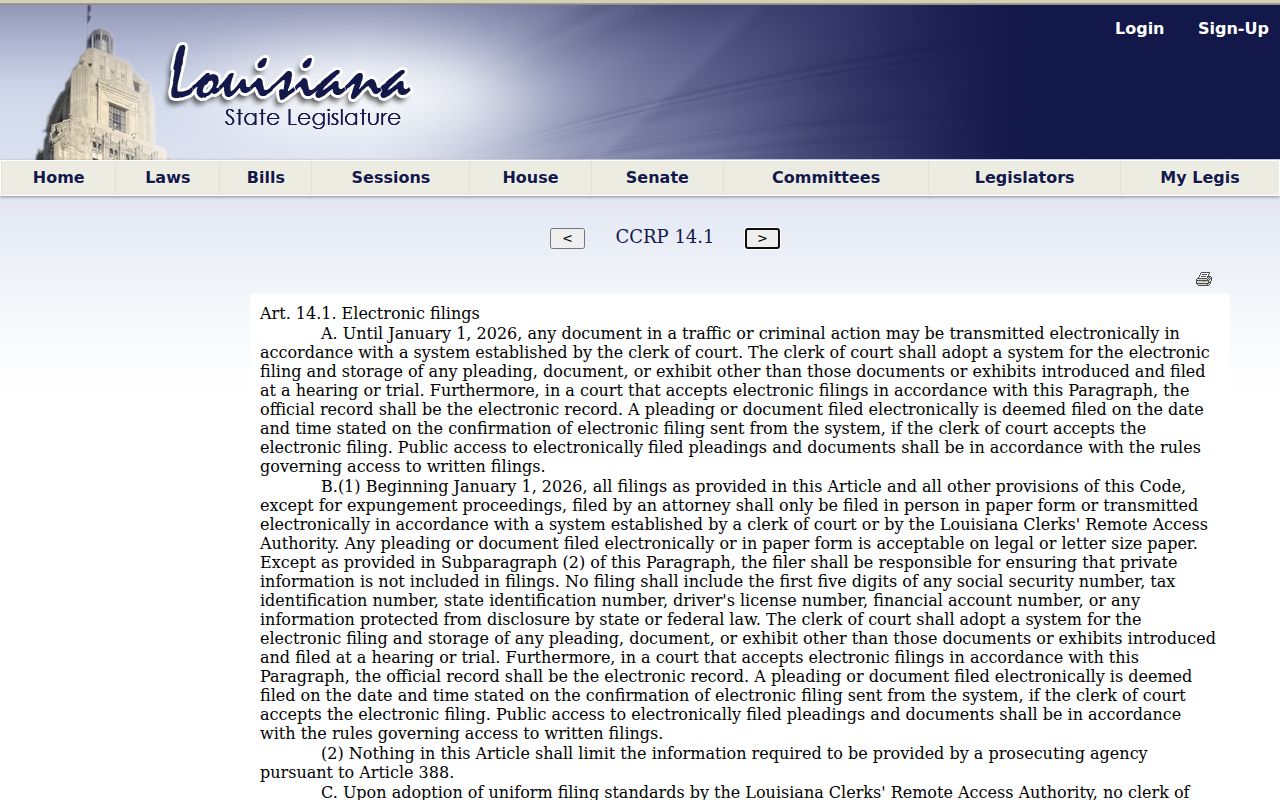
The official Louisiana electronic-filing statute makes clear that electronic records are open to the public in the same manner as written records when the system is used. Access is subject to redaction and other lawful limits.
E-filing changes how an Avoyelles document gets filed and stored. It does not open every historical file, exhibit, sealed item, or civil docket image to a public browser. Some material simply stays beyond that reach.
Who Can See Civil Dockets
Who may look? Louisiana Public Records Law generally gives an adult the right to inspect or copy public records. That right is subject to exceptions, redaction, and asking the correct custodian. In Avoyelles, the picture can be layered. A civil docket chronology may be public. But an image, a protected identifier, or a specially governed filing faces different limits. Adoption, tutorship, interdiction, protected-person, medical, and similar sensitive matters deserve particular care. And an online entry never overrides a statute or court order restricting access.
Key rules for Avoyelles civil access:
La. R.S. 44:1 defines public records broadly while preserving exceptions created by other law.
La. R.S. 44:31 gives adult requesters inspection and copying rights subject to those exceptions.
La. C.C.P. art. 14.1 recognizes electronic filing while requiring protection of specified personal identifiers.
Coming up short in an Avoyelles civil search? Confirm the court and division first. Then ask the Clerk whether the item is online, at the counter, obtainable through an approved request, or lawfully restricted. That beats assuming a missing result means the full case history is empty.